
6 Ways Mixed-Use Developments Can Create More Resilient Cities
Written by AD&V®
ABOUT THE AUTHOR | AD&V® is dedicated to advanced and energy-efficient sustainable architecture & interior design that enhances people’s experience of the world and improves their lives.
RESILIENCE HAS BECOME ONE OF THE DEFINING CHALLENGES AND OPPORTUNITIES OF CONTEMPORARY CITY-MAKING.
From climate shocks and infrastructure failures to economic volatility and shifting demographic needs, cities are being asked to do more with less while remaining livable, equitable, and economically competitive. In that context, mixed-use development is not simply a planning preference or a lifestyle amenity. It can be a resilience strategy—one that helps cities absorb disruptions, recover faster, and evolve with changing conditions.
When thoughtfully designed, mixed-use environments build resilience across four interconnected dimensions: environmental, social, economic, and infrastructure. Below are six ways mixed-use development can meaningfully strengthen the resilience of cities, especially in places where climate impacts and resource constraints are part of daily reality.
1. DIVERSIFYING LOCAL ECONOMIES
Single-use districts are often vulnerable to single points of failure. A business park that empties after 5 p.m. has one rhythm and one primary revenue stream. A tourism-only area can be disproportionately impacted by seasonal swings, global disruptions, or sudden shifts in travel patterns.
By contrast, mixed-use development weaves together multiple activity types such as housing, retail, services, office, hospitality, civic, and cultural uses—so that a neighborhood can continue to function even when one sector slows.
That diversity matters because resilience is partly about redundancy and having multiple ways for a system to keep operating. A mixed-use district can maintain foot traffic, support small businesses, and preserve jobs through economic cycles because it doesn’t rely on a single use to generate vitality.
2. REDUCING ENVIRONMENTAL IMPACT
Many cities’ emissions footprints are closely tied to transportation and sprawling patterns of growth. Mixed-use development help reduce those impacts by bringing daily needs closer together, like housing near jobs, services near transit, and amenities near public spaces.
When people can walk to a café, a clinic, a grocery store, a school, or a park, the neighborhood becomes less dependent on cars and more capable of functioning during disruptions (fuel shortages, road closures, storms, and supply chain delays).
Compact, well-connected districts also support more efficient infrastructure investment. Shorter utility runs, shared systems, and coordinated stormwater strategies can reduce long-term maintenance burdens. In resilient cities, “efficiency” isn’t just about cost; it’s about reducing points of breakdown and ensuring services can be restored quickly when interruptions happen.
3. STRENGTHENING SOCIAL CONNECTIVITY
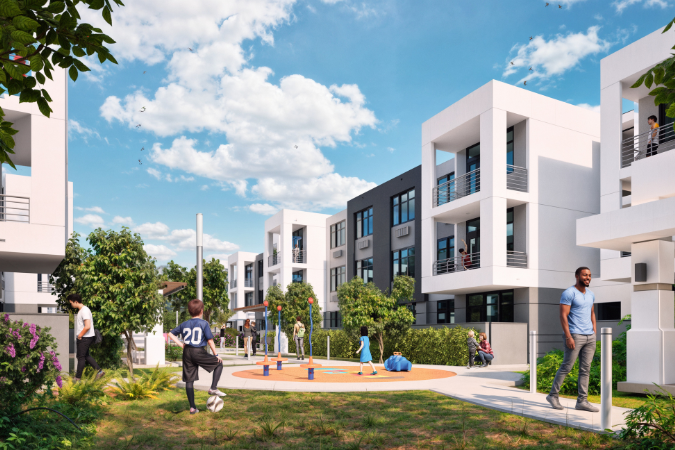
Resilience is not only physical, but also deeply human. After any emergency—whether a hurricane, a heat wave, a blackout, or an economic downturn—communities recover faster when neighbors can stay connected to offer each other support. Shared spaces offer a backdrop for this to happen naturally.
Mixed-use environments can foster these networks because they create everyday collisions: residents meeting on sidewalks, families gathering in plazas, workers supporting nearby businesses, and people across age groups sharing public amenities.
This social fabric is vital. Mixed-use places that are active throughout the day and evening can also enhance perceived safety and comfort through “eyes on the street”, a steady presence that discourages neglect and supports community stewardship.
4. IMPROVING INFRASTRUCTURE EFFICIENCY & CREATING REDUNDANCY
The future of resilience includes smarter, more integrated infrastructure systems that can keep basic services functioning during disruptions. Mixed-use developments can be ideal candidates for:
Shared energy solutions (e.g., solar + battery systems, microgrids)
District-scale cooling strategies in hot climates
Water capture, reuse, and stormwater management
Waste reduction and loading efficiencies through consolidated services
The logic is simple: when many uses coexist, there are more opportunities to design shared systems that reduce load and provide backups. A district that can sustain partial operation during grid instability or manage stormwater onsite reduces strain on citywide networks and accelerates recovery.
5. SUPPORTING HOUSING DIVERSITY & DAILY ACCESSIBILITY
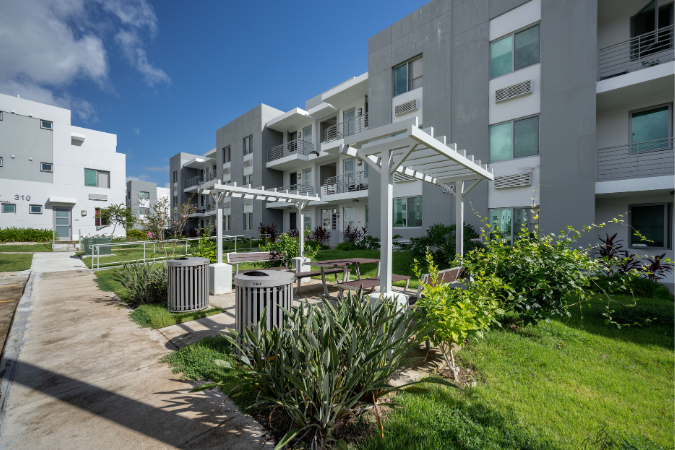
A resilient city is one where people can remain in their community as their life circumstances change—where young professionals, families, seniors, and essential workers can all find pathways to live near jobs and services. Mixed-use development can support that by enabling housing variety: different unit sizes, price points, and typologies within proximity to daily needs.
This is not only a social good; it’s a resilience multiplier. When residents can access necessities without long commutes, communities are less vulnerable to transportation disruptions and economic shocks. When workers can live near employment centers, local businesses retain staff, and stability improves.
6. DESIGNING FOR CLIMATE ADAPTATION & FUTURE UNCERTAINTY
Resilience requires confronting the realities of climate risk—flooding, sea-level rise, extreme heat, stronger storms, and more frequent infrastructure strain. Mixed-use development can play a direct role in adaptation by supporting:
Elevated or floodable ground-floor strategies
Durable, repairable materials and resilient detailing
Shade-first urban design, trees, canopies, arcades, and low heat‑absorption surfaces
Passive survivability, including natural ventilation, daylighting, and thermal comfort strategies that help buildings remain habitable during outages
Flexible ground planes, where uses can change if risk conditions evolve over time
Because mixed-use districts are often long-term investments with multi-phase buildouts, they provide a framework for planning with uncertainty—building today while leaving room for tomorrow’s realities.
MIXED-USE AS A FRAMEWORK FOR RESILIENT URBAN FUTURES
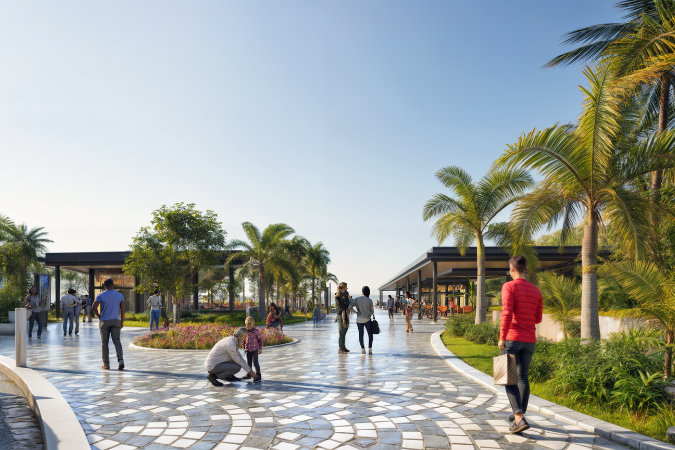
Mixed-use development can help cities become more resilient not by chasing trends, but by designing environments that perform socially, environmentally, and economically under changing conditions. That’s the heart of designing Places of Purpose®: places that support everyday life now and keep supporting it when conditions are harder than expected.
FURTHER READING: 5 REASONS MIXED-USE DEVELOPMENTS ELEVATE THE HUMAN EXPERIENCE